


Most People Do Not Realize They Need a Digital Locker Before They Can Own a Single Share
India’s stock market has attracted millions of new participants over the past few years, yet a surprising number of first time investors still do not fully grasp why a particular type of account sits at the foundation of every equity transaction they will ever make. A Demat account is used to hold shares and securities in electronic format. The simplest way to think about it is to compare it with a regular savings account at a bank. Just as a savings account allows easy access to funds while offering security from theft and mishandling, a Demat account does the same thing for an investor’s securities. The term itself comes from the word demat erialisation, which refers to converting physical share certificates into electronic equivalents. It was first introduced in 1996 by NSE, and since that time, it has become the backbone of how securities are stored, transferred, and tracked across the entire Indian financial ecosystem.
No Account Means No Application, and There Are No Exceptions to This Rule
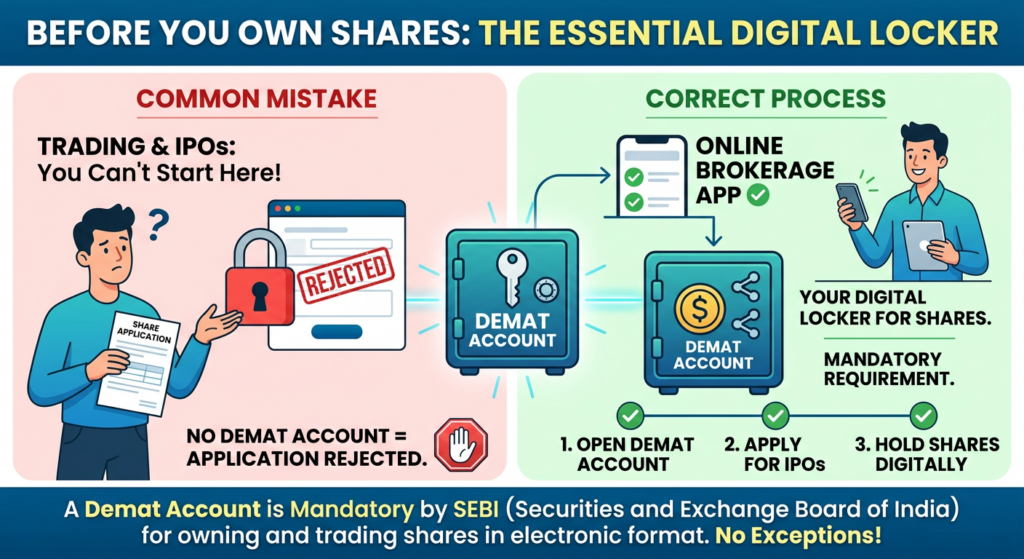
Many people develop an interest in the stock market specifically because they hear about a company going public and want to be part of the action. However, what they often discover at the very last moment is that they cannot even submit an application without having the right infrastructure already in place. A demat account opening is mandatory if a person plans to apply for an IPO, mainly because all shares exist only in electronic formats and a demat account is required for holding those shares digitally. In case a person applies for a subscription without a demat, the application may even be rejected outright. This is not a minor technicality that can be worked around. It is a hard requirement set by the Securities and Exchange Board of India, and no broker or banking platform has the authority to override it. The investor who waits until the subscription window opens to begin the account setup process will almost certainly run out of time and miss the deadline entirely.
Three Separate Accounts Work Together Like Gears in a Machine
Understanding the architecture behind stock market participation helps an investor appreciate why the demat account is just one piece of a larger structure that needs to work in harmony. Opening a demat account is the first step towards starting an investor’s journey because to start trading, a person will need three things working together, which are a bank account, a demat account, and a trading account. The demat account is merely a deposit account used for holding securities, the trading account is necessary for making real buy and sell transactions, and the bank account is needed to store the cash used for those trades. When an IPO allotment is finalized, the shares land in the demat account, while the funds are pulled from the linked bank account. Having a demat account is essential to invest in an IPO, and while having a trading account is not compulsory at the application stage, without it, the investor would not be able to sell the allotted shares once the company lists in the secondary market. This distinction catches many first time investors off guard because some of them open only a demat account and then realize on listing day that they have no mechanism to sell.
The Old Cheque Book Days Are Gone and Good Riddance to Them
The process of applying for public offerings has evolved dramatically since the early days of Indian capital markets. Back in the early 1990s the entire IPO process used to be complicated and intimidating. A person would apply for an IPO in a fixed price issue by issuing a cheque to the bankers, and it would take nearly three months just to find out whether an allotment was received. During that entire waiting period, the application money remained locked in without earning a single rupee in interest. The introduction of ASBA transformed this experience completely. Under this system, the Application Supported by Blocked Amount is a method in which the bank account only gets blocked to the extent of the application amount but does not actually get debited. The investor continues earning interest from the bank on the blocked sum, and the actual debit happens only on the date of the actual allotment. This means the investor’s money keeps working even while the application is being processed, which is a significant improvement over the old system.
Smart Investors Build the Runway Before the Plane Needs to Take Off
The investors who consistently participate in public offerings without stress or last minute technical failures are the ones who set up their entire infrastructure well before any subscription window opens. The documents required to open a demat account are limited and can be submitted digitally via electronic KYC for instant account activation. A demat account stores shares and securities digitally, removing the burden of paperwork and reducing risks linked to physical certificates such as theft, loss, or accidental damage. Opening an account requires basic KYC documents such as PAN, address proof, bank details, and income proof only for those who wish to trade derivatives. By having the account active, linked to a verified bank account, and connected to a UPI ID that matches the same PAN, an investor eliminates nearly every common reason for application rejection. The lesson for new investors is simple and worth repeating. The demat account is not just a formality or a bureaucratic checkbox. It is the structural foundation upon which every successful IPO investment is built, and treating it as an afterthought is the fastest way to miss opportunities that do not sit around waiting for unprepared participants.
Check out more blogs at Ureadit.com