


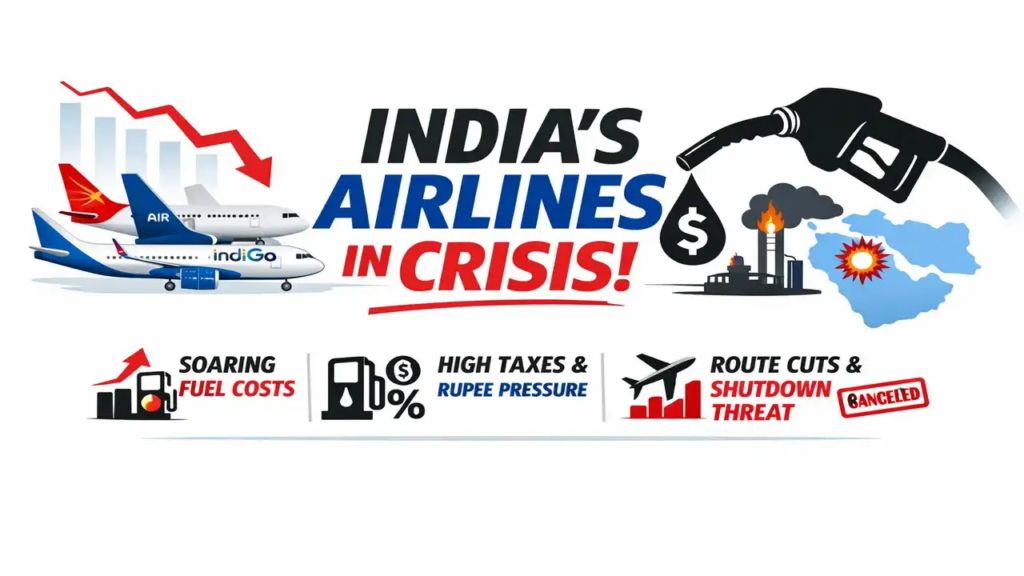
India’s aviation sector was once the crown jewel of its economic growth story — a market of over a billion aspirational travellers, expanding middle class, and a government committed to connecting every corner of the country. Yet today, that same sector is reeling under the weight of crippling debt, airline collapses, skyrocketing airfares, and a regulatory environment struggling to keep pace. The India airline crisis is not a single event — it is a slow-building storm that has finally made landfall.
The Background: A Market Built on Thin Ice
India is the third-largest domestic aviation market in the world. Air passenger traffic grew exponentially through the 2010s, with budget carriers like IndiGo, SpiceJet, and Go First democratising air travel. But beneath the booming ticket sales was a financially fragile ecosystem:
- Airlines operated on razor-thin margins, subsidised by growth rather than profitability
- Fuel costs — accounting for nearly 40% of operating expenses — are among the highest in Asia
- The rupee’s persistent depreciation inflated aircraft lease costs, which are dollar-denominated
- Airport infrastructure lagged demand, creating congestion and inefficiency
The Breaking Point: Collapses and Groundings
The crisis intensified with a series of high-profile airline failures. Go First, once a celebrated low-cost carrier, filed for insolvency in 2023, leaving thousands of passengers stranded and creditors holding the bag. The collapse exposed deep structural vulnerabilities:
- Pratt & Whitney engine failures grounded nearly half of Go First’s Airbus A320neo fleet, crippling operations
- Accumulated losses crossed ₹10,000 crore, with no viable rescue in sight
- Jet Airways, India’s oldest private carrier, had already folded in 2019 — a wound the market never fully recovered from
- SpiceJet faced multiple DGCA safety notices, temporary fleet groundings, and acute cash flow problems
The Passenger Pain: Skyrocketing Fares and Chaos
For ordinary travellers, the crisis translated into misery. With fewer airlines and reduced capacity, airfares surged to historic highs — often rivalling international flight costs for domestic routes. Key grievances include:
- Last-minute cancellations with little to no refund mechanism
- Ticket prices on popular routes like Delhi–Mumbai crossing ₹20,000 during peak periods
- Overloaded airports unable to handle irregular operations and diversions
- Poor consumer protection frameworks leaving passengers with minimal recourse
Regulatory Response: Too Little, Too Late?
India’s aviation regulator, the Directorate General of Civil Aviation (DGCA), has faced intense scrutiny for its handling of the crisis. While it has taken steps including enhanced safety audits, fleet-grounding orders, and consumer advisories, critics argue the response has been reactive rather than preventive. Systemic issues include:
- Slow-moving insolvency proceedings that kept grounded aircraft in limbo for months
- Unclear policy on fare caps — a politically sensitive but economically complex issue
- A gap between rapid market liberalisation and the regulatory maturity needed to supervise it
The Tata Factor and IndiGo’s Dominance
Amid the chaos, two forces have come to dominate Indian skies. IndiGo — with over 55% market share — has emerged as the sector’s only consistent profit-maker, benefitting from competitor collapses. Meanwhile, the Tata Group, having acquired Air India and Vistara, is betting on a long-term consolidation play. The risk? A duopoly that eliminates competition, stifles price correction, and ultimately hurts the very consumers aviation growth was meant to serve.
What Lies Ahead: Turbulence or Recovery?
The path forward for Indian aviation is neither simple nor certain. Experts suggest a multi-pronged approach is essential:
- Fuel tax reforms — reducing state-level ATF taxes could meaningfully lower operating costs
- Stronger insolvency mechanisms specific to aviation assets, particularly aircraft and slots
- Encouraging new entrants with transparent licensing and incentive frameworks
- Investing in Tier-2 and Tier-3 airport infrastructure under the UDAN scheme to diversify route pressure
- Consumer protection overhaul with real-time grievance redressal and mandatory compensation standards
Conclusion
India’s airline crisis is a mirror held up to the contradictions of its growth story — ambition without adequate foundation, speed without structural readiness. For a country that needs aviation connectivity more than almost any other, getting this sector right is not optional. With bold regulatory reform, fair market conditions, and genuine consumer-centricity, India’s skies can still become everything they were once promised to be. Until then, expect more turbulence.